
Dairy Industry Advocate: Inside ADPI's Ambassador Program
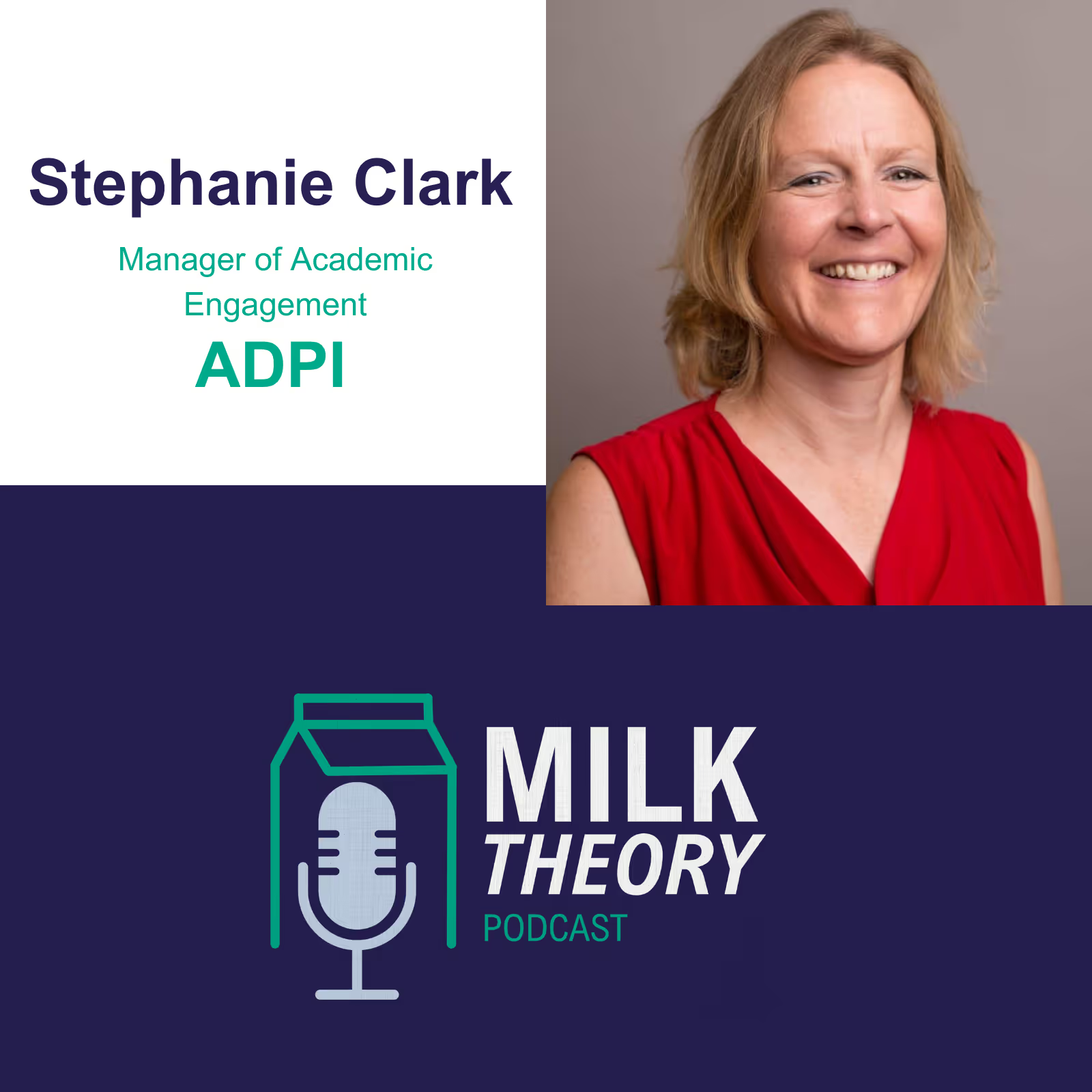
Today on Milk Theory, we’re diving into the essential link between academia and the dairy industry. Stephanie Clark, Manager of Academic Engagement at ADPI, joins us to share her unique path—from childhood goat-keeping to becoming a leader in dairy science.
Stephanie pulls back the curtain on the ADPI Ambassador Program, a vital initiative designed to bridge the gap between students and industry professionals. We discuss:
- How the program is fighting misinformation around dairy topics like lactose and rBST.
- The life-changing impact of mentorship in the dairy sector.
- How you can get involved: We’re looking for mentors and volunteers nationwide.
Ready to shape the next generation of dairy leaders? Learn more at adpi.org/ambassador-program.
Ben Jewett:
Hey, welcome to the Milk Theory Podcast. Today we are joined by with Stephanie Clark.
Stephanie Clark:
I'm the Manager of Academic Engagement, at ADPI
Ben Jewett:
Thank you for joining us. So I kind of wanted to start by letting our listeners get to know you a little bit.
Stephanie Clark:
Okay.
Ben Jewett:
So how did you get started your career path to where you're at now? Why dairy? Why did you get into this?
Stephanie Clark:
Sure. Well, about 50 years ago, a little bit more than 50 now, my mom got me a dairy goat for my seventh birthday.
Ben Jewett:
Whoa. Okay.
Stephanie Clark:
Yep. We had a small farm in Massachusetts, and she brought home a Nubian dairy goat kid who we named Hillary Black and White spotted. Still picture her in my mind. She's my very first. She's adorable. She was adorable, and it just started us on that path because, well, when you have a goat, you breed that goat and dwell, you have milk, and then you do something with it. So basically, probably by 10 I was making cheese, probably really? With goat milk probably, and believe it or not, I did not know anything about food science. I didn't know you could do that. But in junior high, high school, I would make cheese and I would do science fair projects with milk, but I didn't know that there was a career option in that because nobody ever told me because they probably didn't know. So I went to college wanting to be a vet.
So I started out in animal science. I finished my bachelor's degree, but during my bachelor's I wanted to do some undergraduate research on goat milk. So I went to my advisor in animal science and I said, I want to do undergraduate research on goat milk. And the advisor said, oh, that's not animal science. That's food science. And so I went over to the food science department, they directed me over there, introduced myself, and I took a class and milk and frozen desserts, and I said, oh, this is for me. So I finished that degree. Then I stayed for my master's and PhD.
Ben Jewett:
Wow.
Stephanie Clark:
Doing goat milk research.
Ben Jewett:
Yeah. Oh, that's so cool. That background is amazing, actually. Just starting with your own little goat. Really, really cool. So did that kind of lead into where you have a, because I know you have such a passion for the ADPI Ambassador Program, is that kind of what's led you into this type of career?
Stephanie Clark:
Okay. It's probably a combination of things. So I was involved in 4H, and so that that's essentially an ambassador program for agriculture largely. So I think I always had a passion for teaching and finding the truth and communicating facts about animals and food and agriculture. And so I think that may have been the beginning. Then doing my undergraduate research and being in food science kind of all led to that. But as far as ADPI specifically, I'd been in academia for 26 years, and it was time for a transition largely because of family changes, changes in life, giving my spouse more priority to do something with his career rather than my career as much. And we decided to move down to New Mexico. So that was a big, big change. So left the official formal academic environment, went down there, but not really far from academia because we live in Las Cruces, which is where New Mexico State University is. KJ saw on LinkedIn that I was not working at Iowa State, and she said, would you like to come over to ADPI and help launch the ambassador program? I said, absolutely. That's right up my alley because it's still engaging with academic institutions because my passion for students, I love students. I still work in academia. I volunteer over at NMSU because I just love working with students.
Ben Jewett:
That's awesome. That's awesome. So you help start the ambassador program?
Stephanie Clark:
Yes.
Ben Jewett:
So, what is like can just to listeners who don't know what it is, what is the ADPI Ambassador Program?
Stephanie Clark:
Sure, sure. It's essentially a program designed to future proof the dairy industry, because we know students are our future. We need to expose them to dairy.
Ben Jewett:
I agree. Yeah.
Stephanie Clark:
The incredible number of opportunities there are in dairy. So you yourself being an ambassador, that there are opportunities for students in finance, in marketing, in production, in the animal side. It goes on and on and on. You talked about marketing. That's your expertise. Your audience had more than just marketing students. They did, and they maybe had no clue that you could work in the dairy industry with a marketing degree. It's not the first thing you think of. No. When you think of dairy, you think of cows going to milk cows, or maybe you're going to feed cows so much more. So much more. We know that in the industry, but students don't. So what we do is we send ambassadors out to share their career stories, but also share about ADPI. So students learn that there are resources available to them. So for instance, if they have to do a term project or they have to write a paper for a class, if they happen to be taking a class on global economics of cheese, maybe they have to do a paper for a class.
They can get some resource, global, global sales information from our website. They can take our DI 360. If they are in a food science program that doesn't offer dairy classes, they can have access to scholarships if their parents work for an ADPI member or they go to an ADPI member school. So we alert them about those things. We also provide opportunities for them to get mentoring from someone who's in a career, a lifelong career, or maybe just starting out in a career. So we try to match them with somebody that maybe shares similar background or maybe they grew up in a similar place, or they are in California, whatever it may be. I try to find a reason to match different mentors with different students. But the whole goal is to help these students navigate life as a student and get them on the right path to make a good career choice. And it may or may not be dairy. A lot of the students that I've matched are not dairy. They just happen to have gone to a dairy career spotlight featuring someone, for instance, like you and saying, wow, that was inspirational. I believe that somebody could help me.
They're not necessarily going to end up in dairy. That is okay. But exposing them to someone who can answer their questions and show compassion and help them get an understanding of work-life balance can make a difference, and hopefully give them a positive impression about dairy that might last their lifetime, which helps us too.
Ben Jewett:
It's true.
Stephanie Clark:
I mean, ultimately, we want more students in this industry. We want people to replace us when we retire.
Ben Jewett:
For sure.
Stephanie Clark:
We'd love that, but there's more to it than that.
Ben Jewett:
Okay.
Stephanie Clark:
Yeah.
Ben Jewett:
Do you see, does ADPI kind of recognize the discrepancy between maybe the younger generation not really seeing what's in dairy. Do you guys notice that? Is that something that you guys think about or?
Stephanie Clark:
Sure. The younger populations are getting further and further away from the farm and further and further away from where food is produced. So yes, there is a disconnect. So there are some aha moments. Yep. We do see that.
Ben Jewett:
Yeah. That's interesting. No, I remember when I joined the dairy industry, I learned what milk protein concentrate was and blew my mind. And so I felt like the ambassador program for me was a really important thing for me to be able to go and show people different things. What are the challenges that, the biggest challenges that you're facing with this right now?
Stephanie Clark:
With the ambassador program or with the dairy industry?
Ben Jewett:
I think we'll start with the ambassador program.
Stephanie Clark:
With the Ambassador program. I need more volunteers. I would really love for people listening to your podcast to say, I have something to give back, and I want to see this industry continue to thrive beyond me. We have about 41, I think academic institution members of ADPI and I have about 55 to 60 volunteers, but some of those volunteers want to be mentors and not necessarily go speak at a university. So I'd like to have a few more of both. Both for sure, both, but people throughout the country so that if I need an ambassador to go to North Carolina, it may just be a few hours drive rather than a flight. For
Ben Jewett:
Sure.
Stephanie Clark:
Yeah. So that's kind of what I'm looking for. I'm looking for more ambassadors throughout the country who can do the career spotlights, as well as mentors throughout the world who are members of ADPI, who can serve as a mentor in any major. I might have a lot of food science volunteers, but I may be short on economics of volunteers, but I have students who want a mentor, and if I don't have that economics mentor available, then they have to wait, and I'd love to be able to match 'em. Right. When the student says, I'd like a mentor, I'd like to be able to give them a mentor for sure. So I feel like I need a balanced pool. So that's my biggest challenge is having a balanced pool of the students and the mentors. Yeah.
Ben Jewett:
Yeah. Even when I went to BYU Idaho, my alma mater, there was a lot of food scientists kids there, but I did have a lot of business majors and a lot of communication majors, and I think there's a room to grow absolutely there for sure. For the innovation with food scientists, crucial to our industry. Getting the message out and sharing how cool it is is also crucial, and the logistics of it.
Stephanie Clark:
And we have a number of students, for instance, who are interested in sustainability, but that pool of expertise is quite a bit smaller than the pool of expertise in food science.
Ben Jewett:
For sure. You have to find the right people you have that they want to do it. So that makes a lot of sense.
Stephanie Clark:
Yep.
Ben Jewett:
What would you say are the issues you think you're seeing within the dairy industry?
Stephanie Clark:
With the dairy industry? A tremendous amount of misinformation and even disinformation, I would say. And I've always been one who wants to myth bust ever since I was in 4H to help people understand the goodness of dairy and agriculture. So when I hear somebody say something negative or something false, I immediately feel the need to correct it. So part of my research when I was in academia was consumer research and consumer education, and I think we need more people doing that, and we ourselves need to be ambassador ambassadors for the dairy industry, not be afraid to speak up in the grocery store. I do it so often. Yeah. My spouse sometimes gets embarrassed. He'll kind of try to pull me away or he'll walk away when he sees me correcting something I hear in the grocery.
Ben Jewett:
No, it's inspirational hearing that, yeah, I fully agree. Being new into the industry, I like seeing it from a different point of view. I believed some of those false narratives.
Stephanie Clark:
Because you hear 'em enough!
Ben Jewett:
Yeah!
Stephanie Clark:
And you think it's true. So for instance, I fear, and this isn't an intentional, this is not intentional, but I fear that people are going to become more opposed, or let me phrase it this way. I fear that we're going to have a lactose intolerant generation soon because there's so many lactose free products out there in the market. I fear that people are developing this sense that lactose is bad, period. Lactose is bad. I shouldn't consume it. I'm going to get stomach ache if I have lactose. Whereas the majority of the population is not lactose intolerant. There are a lot of people who have lactose maldigestion, but not lactose intolerance. So we as a dairy industry need to inform one another of the reality there that even though we've got a lot of lactose free products and they're popular and they're meeting a niche, so many people are buying those products because they have a long shelf life, not necessarily because of the lactose free, but it's going to become in the younger and younger generations, they're going to think, oh, I need to avoid that. Just like I need to avoid RBST.
Ben Jewett:
True.
Stephanie Clark:
Right. That's misperception that RBST is bad. RBST is going to make me mature earlier. No, that's not true. Recombinant bovine somatotropin does not affect humans. It affects cows. So there are misperceptions about both of those things, for example, and we as an area industry need to understand the reality to be able to share and break those misperceptions and not be afraid to share those stories.
Ben Jewett:
Yeah. I think that being bold too, the dairy industry, in my opinion, has been, we've held back a lot and it's like, I think we could be bold. We have the science to back it.
Stephanie Clark:
I one hundred percent agree. I think we're very conservative and afraid to offend, and I understand that, but it hurts us. It does. When people avoid RBST or avoid lactose when they really don't need to.
Ben Jewett:
Yeah, absolutely. It limits a lot of things.
Stephanie Clark:
It does. It does.
Ben Jewett:
So well, if somebody wanted to volunteer, we're going to go back to the Ambassador program now. If somebody wanted to volunteer, how could they get ahold of you or how could they get and do that?
Stephanie Clark:
Yes. Everything's on our website for sure. You can find it by going to adpi.org. I think it says Forge slash Ambassador Program. I believe that's the address. So I should have looked it up before we had this podcast, but you could maybe, I don't know if you can put it as a little search. Yeah. One of those little type things underneath my name when you introduce me or whatever. I don't know. Yeah, we will. We'll just get it in there somehow, but they can volunteer just by clicking the little link there to volunteer as an ambassador. It says it right there, and either end of the program, either as a career spotlight or a mentor, or both. We've had some people who've done both.
Ben Jewett:
Really?
Stephanie Clark:
Yes.
Ben Jewett:
Okay. That's awesome.
Stephanie Clark:
It really is.
Ben Jewett:
It's awesome. No, I really appreciate you coming on. I really liked the Ambassador program.
Stephanie Clark:
Thank you.
Ben Jewett:
It was awesome for me to go back, but I was so blown away by the dairy industry, and I want people to see that.
Stephanie Clark:
So do I.
Ben Jewett:
I'm really appreciating that you came on the podcast with us.
Stephanie Clark:
My pleasure.
Ben Jewett:
Yeah. It's so good to talk with you and yeah, we'll see you guys next time.