
Following the Milk: How Product Carbon Footprints Unlock Dairy Value
Carbon Accounting & The Future of Dairy Sustainability
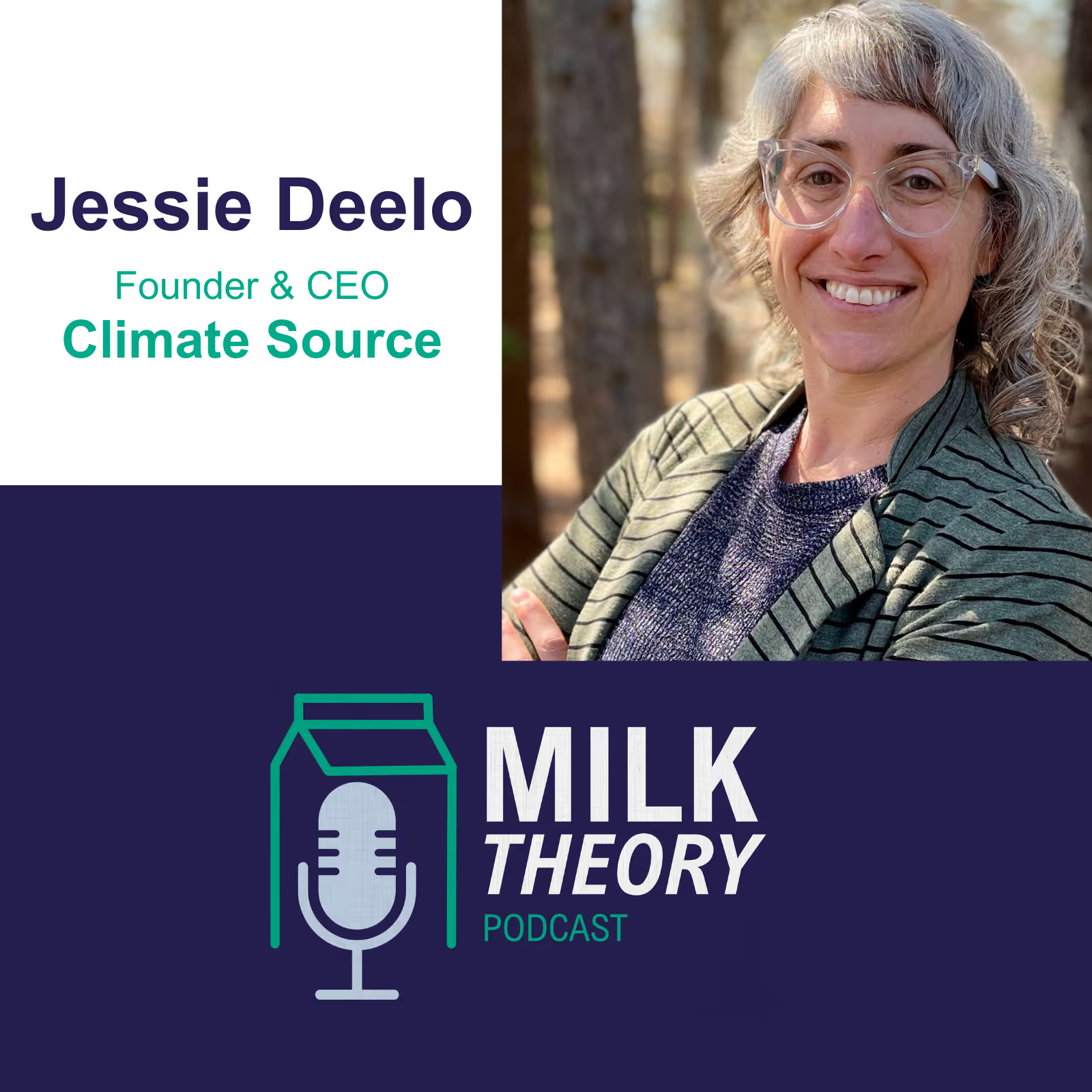
As the dairy industry moves toward aggressive methane reduction targets, the ability to accurately track and manage emissions has never been more critical. On this episode of Milk Theory, we discuss the evolution of carbon accounting with Jessie Deelo, CEO of The Climate Source.
Recorded at the ADPI conference, this conversation explores the technical challenges of tracing emissions throughout the dairy value chain. Jesse explains the advantages of Product Carbon Footprints (PCFs) in providing a transparent, equitable way to allocate emissions across diverse product lines. We also analyze the role of supply chain infrastructure, the necessity of co-financing climate-smart agriculture, and how procurement and operations teams can align to meet sustainability goals.
Topics covered include:
- Technical methodologies for emission allocation in dairy processing.
- Unlocking capital for long-term climate solutions.
- Bridging the gap between farm-level data and corporate reporting.
Learn more about carbon management for the dairy industry: climatesource.ag
Jeremy Pike:
Okay, welcome everybody again to another episode of Milk Theory Podcast. I'm having a conversation today with Jessie Deelo, Founder and CEO of the Climate Source. Jessie, thanks for being here.
Jessie Deelo:
Thanks for having me, Jeremy.
Jeremy Pike:
Alright, well today's going to hopefully be an exciting conversation. Before we maybe get into the meat and potatoes of it, can you give me a little bit of your background and share kind what brought you to where you're at today within the climate source and what brought you to that sustainability crossroad that we're at?
Jessie Deelo:
Yeah, sure I would happy to. So I'm actually from Chicagoland area, so glad to be back here for this day. So I grew up outside the city and decided I wanted to be a farmer. And so after I went to college, I spent 10 years working with others, learning how to farm, and eventually had my own operation out in Massachusetts. I worked in extension helping other farmers adopt sustainability practices and doing research on integration of those practices in their cropping systems. And then I got interested in the marketing side of things. So I moved over to doing collective impact for market development, working on the non GMO market about 10, 15 years ago. That led to setting up my own independent consulting firm, which I ran for a bunch of years working with large food companies on their sustainable supply chain programs. After doing some startup work, I came back to consulting in 2023 and started the climate source and brought together a lot of things that we had been doing in other places. So we're a team of about seven and growing and we do three main things, supply chain, program design and execution, carbon accounting and co-financing strategies.
Jeremy Pike:
Awesome, thank you for sharing that. And so obviously today I do want to drill down to the carbon accounting section of your work. And so when we look, and maybe this is the softball question, but when we look at the dairy value chain today, what are some of these problems that your team is focused on solving and specifically as we look at maybe dairy sustainability, accounting, carbon accounting?
Jessie Deelo:
Yeah, I think with the challenge that we're trying to solve as a perpetual challenge we've had in sustainability is how do we find the market value of doing this work? We can compel farmers and suppliers to take action on things that are good for efficiency and productivity, but when we start to edge into the space of this is good for the general environment or people, it's really hard to make that business case. So what we're really excited about doing in sustainability is trying to figure out how do we connect to those impact metrics to real market value? Because we believe if that market case is there, then it will compel more producers to look at what they're doing and say, okay, actually I have my data organized in a way to tell that story and to generate that impact claim, we got to have some more pull in the marketplace, which means that the end of the supply chain has to signal they care about this too.
Jeremy Pike:
Absolutely. Yeah. So you mentioned maybe some of the challenges there and we can certainly riff on that for a little bit as far as the downstream side, the downstream side caring or wanting to be actively engaged. And so I guess maybe let's get right into it. What are some of those considerations that you look at or that somebody looking at footprinting and accounting, what do we mean when we talk about that?
Jessie Deelo:
Yes, it is not an easy space to work in, as you know. So in order to create a carbon footprint, we need to calculate those emissions with a bunch of different models and tools, which requires a significant amount of data. So we're lucky in the US that we can rely on the innovation centers and national Milk's farm Es to get the Farm Gate number. But then when you try to move from farm gate through processor gate, there's a lot fewer tools available to us as you know. And so we have to figure out how are we going to centralize the data from the farms, from transportation, from processing energy, which means we have to go all the way into the processing facility and kind of map how products are flowing through. And that is what allows us to create the product carbon footprint. So it is a significant amount of data to get to the end number, but I wouldn't say that that's a reason to not do it right. If we have good architecture in the way that we're going to pull this information through, we can use proxy data, we can do secondary information, but I think the point is that you need to have infrastructure in the supply chain so that you can translate those impact on farm through the value chain.
Jeremy Pike:
Absolutely. And I know when we think about it and we look at it, you brought up a few good points, data proxies. So data quality obviously is important, methodology is critical alignment, industry acceptance, all of those are great words, buzzwords that maybe I would love to think in the alternate universe we have. But obviously that's not the case and hence why you and team have developed one way of doing what we feel is a good accurate representative way of accounting for those intensities. And so when we look at product carbon footprints, more specifically drilling down now on the ingredient side, back to the question about data quality or methodology or standardization, where do you see, we're here at A DPI annual conference, ADPI is the ingredient standard. They are the reputable source within the industry for what makes a milk protein concentrate, milk protein concentrate. So data quality, like I said, methodology alignment. How does all of that then tie into product carbon footprint and product carbon footprint specific to say an ingredient down to this individual ingredient level?
Jessie Deelo:
Sure, yes. So I guess maybe I'll start with saying why do we even want to think about PCFs? Right? So we have been aligned as an industry towards carbon intensity at the farm level, and the reason being that 80 to 90% of our emissions in the dairy value chain are coming from the farm. But the challenge that we're having there is that buyers don't buy farm milk. Buyers buy MPC 80, they buy ice cream base mix, they buy different kinds of cheeses. So there's been a lot of estimates and assumptions that have been used to calculate the footprint for the buyer at the end of the value chain. And those have been really effective tools. Those guys needed to figure out what's my footprint, what's my target, how should I invest to meet my target? But then when you think about, okay, well in order to get actual information from the value chain, I need to get past these estimates.
So I look to my suppliers and I nudge, push, motivate them to help me get better numbers. And that means that dairy cooperatives and processors in the US are having to go out on farm and grab those carbon intensity values from the farm and pull them through. And that's your scope three emission factor. The problem is that the buyer, we have no way of knowing how one gallon of milk turns into many, many different products, but the processor has that relationship with both the farm and the buyer. So they're in the perfect position to figure out, okay, how do I embed all of the emissions from my source ingredients, from my transportation, from my energy into a product carbon footprint? And in that way, I would be correctly distributing the emissions to all the products that are coming out of my facility each day. We feel that that is the most fair and credible and authentic way to do carbon accounting, but it is different than what has traditionally been done so far. But we think there's a lot of market value and there's a strong business case for moving towards product carbon footprints.
Jeremy Pike:
Absolutely. Yeah, and that's a great point to bring up and kind of leads me into the tie in point here. Like you mentioned, obviously raw milk comes into a facility, it might turn into two three when I was umpteen different ingredients or streams based on what the solids in the milk or the components of the milk that the end ingredient application is going to be. Right? And so when we look at and use the word allocation, what does that look like? How do we allocate and look at a product carbon footprint for a certain ingredient? And what's kind of the approach that you guys through the climate source and the work you do, how do you guys look at allocation and follow maybe that milk through from the farm side to help again that processor, that that supplier be able to provide an accurate and calculatable repeatable number?
Jessie Deelo:
So we're actually really lucky in the dairy industry that we have a bunch of standards and I would say dairy is further ahead than most other sectors in agriculture. So we rely on international dairy federation's methodology for milk solids, which essentially says you can take a gallon of milk and we'll look at the volumes, the carbon intensity, and then we want to understand the butterfat protein, lactose and mineral percentages because when we have that, we can convert it to fat and protein corrected milk, which is the standard common unit for translating into carbon intensity. So we do everything to the milk solid and then we follow the milk solid as it moves through the processing plant to know these protein solids are going into a variety of protein products and sub products. And so when we're doing allocation, we like to describe it as this is the way that we're going to allocate emissions from all those source materials to the products. It's different than how we do attribution, which is the way that we report those impacts to our customers based on the products they purchased.
Jeremy Pike:
So maybe let's, I don't know if heads are spinning for the folks that'll be listening yet at this point, but you brought up the other a word of attribution. So we're talking two different things then with allocation and attribution. So if I'm making a butter say, and obviously you look at what solids are going into that, that's your fat component that's easy to follow those solids in equal a certain volume or weight of product out in fat and butter. When we then take that additional step to attribution, how does that further then muddy the water or add a layer of complexity to this whole accounting fiasco that we're in the thick of?
Jessie Deelo:
Exactly. Yes, it is a fiasco. So yeah, so with allocation, the first thing we do is follow it physical allocation the whole way through. We don't use economic valuation as a way of doing allocation. So we are actually working in volume-based units, but we believe that allocation is accounting. There's no Tom foolery here. You're just doing math correctly and you're following an accounting logic based on the flow of ingredients. But attribution is where we believe we need to have a little more flexibility. So if your accounting is perfect and it's correct and in credible, then the way that you're going to do attribution when it comes to project investments can be a little bit more so as a fundamental basis for attribution, you're going to say, here's all my buyers. They bought all these products each month, each year, and you guys are now responsible for these emissions based on those products purchased.
Well, let's say that the buyer did a project on farm and they made the investment. How do we carry that project reduction through the value chain? So the way that we're going to manage it is we're going to have full traceability to the farm, and that's very special about the bound area accounting platform. What we've done with Idaho milk producers and others is to rely on that data traceability that you guys have already built and invested in. So we're going to layer that product reduction from farm to product, and then we're going to take that project reduction and say, okay, I know in real life that whole farm milk went into four different products, let's say, but this customer is only buying one, so I need to digitally swap the emissions from other co-products and be able to report it to that buyer. The reason that we can do this using a product carbon footprint methodology is because we have the accounting system full and complete. So when I move a, let's say a carbon reduction from a condensed skim to an MPC 85 that buyer might be using, I will return that condensed skim to the baseline value. And what's really cool about what we've been able to do is we've avoided the risk of double counting. So we use the allocation to do the accounting in a credible and correct way, and then we use the attribution to satisfy customers where they are in different places because not everybody is doing the decarbonization thing. Right,
Jeremy Pike:
Absolutely. And so I guess just to continue to build on that a little bit maybe, so I think the head recking thing for me, and I know we've chatted about this in the past, but when we look at allocation that to me on the analytical side of my brain that is very A to B, it's a very objective exercise. There is a common methodology, which again, maybe there's still opportunity to gain industry alignment with, but it's very objective. There's a methodology to get those numbers. And then what you're saying from the attribution standpoint then is the build of how you interpret those numbers and make them align then with the interest of the downstream customer. That's accurate, right?
Jessie Deelo:
Yes.
Jeremy Pike:
So what may be on your consulting side and the work that you do supporting the folks in the industry, what's kind of your take on where sustainability and the interest Are there folks both maybe am I the crazy one out there on the processor side, that's the only one talking about this? Are there other folks on that supplier level that are interested? Are customers asking for it? We see a lot of these ties back to the changes in the different political landscape influencing maybe willingness for investment, and that's being funneled down to those to customers. They might be backing off, but are you seeing a trend? Is it full speed ahead? Is it kind of slowing down? What's your hot take on that one?
Jessie Deelo:
Yeah, I think at the end of 2025, it was still full steam ahead and people were wanting PCFs more often because they could see that there was this disconnect between their inventory of emissions and their project-based emissions, and they couldn't figure out how to get those two things to sync up. So when you do a PCF, you can actually make them sync up because now your buyer can calculate the product carbon footprint just of what they buy and their projects can be attributed just to what they buy. I do think that the first few months of this year have demonstrated there's a major slowdown in the investment, but what has not changed is the demand for reporting. And in many ways what I see happening in the global landscape of carbon accounting is just more and more complicated reporting. And this I think is a real disconnect with the supply chain because when I look at what these other big consortiums are doing, they start with this really simple supply chain map.
It's just like farm truck facility product customer, no, if you have been inside a dairy facility and see how many times an ingredient is being recycled, it is not a simple supply chain, but they start with a very simple supply chain and then all this really complex accounting methodology, we've had to flip that script. We said we need to follow the emissions based on the actual operations because what we don't want to have happen is that as reporting and disclosures and regulations continue what's happening in California, what has been continuing, but slowing down in the EU with carbon border adjustment mechanism, we believe these regulations will come back. And I think there's also been the benefit of insight from when we've started to see that data flow through and see, oh, I have an opportunity to improve here, or we're really successful here, how do we communicate this better? So I do think that broadly there's a little slowdown in sustainability, but I also think that that is a moment for sustainability to say, all right, well we got to figure out the business case, and that means building a solution that aligns with procurement and finance. So we know we sit side by tide and we try to integrate, but we have to do a lot better job and we have some thoughts about how we can make that happen.
Jeremy Pike:
That is a great point and maybe it will be a good segue here after a minute or so, but I guess one of the things that I heard from that is we look at product allocation and maybe even attribution as a reporting exercise, as an academic exercise, doing the accounting, doing the work. Where do we see that unlock? To your point, how do we get in lockstep with the other cross-functional groups within our business, within any business to say, okay, we're taking our environmental performance from this academic exercise and now unlocking value and creating some sort of commercial strategy or commercial advantage. Where's that unlock and how feasible or what does that look like?
Jessie Deelo:
Okay, I'm going to say that dirty word, "premiums."
So I know everybody says I don't want premiums. I don't want that perpetual on cost. I just want to throw some money. I want to get off my books and then I want that farm to just give me that better number. But that's not how farming works. So most of the farms in the US who are participating in the calculations and the Idaho milk farmers, they're top performers already. So what is left on the table for them tends to be high cost, long-term investments. If we want to have a significant impact on a farm, we've got to look at the manure systems and now we're talking about a piece of equipment or infrastructure that has a 20 year lifespan. There is no buyer program that is going to invest in 20 years, and nor does a farmer want that relationship. So I think we have to figure out a way that we can use transition financing to help those farms unlock those dollars that's going to get them a lower footprint and put them into that ability to sell their environment or performance long term.
I do think though, we need to figure out then how do we bring in a premium just like organic, when organic came out, and I was an organic farmer, full disclosure, and I became a certified organic farmer because of the premiums. It was a compelling reason to run that system, but when organic started, it was a huge premium. It was like a hundred percent of the conventional price. But then it settled down as we found this balance of supply and demand, and I think that we have to get to a place where we can recognize that different products can have different attributes based on the carbon emissions that that product has. And if we built the architecture that is going to allow IMP and others to do it, and I do think that there's a business case to say you can secure that long-term access to a lower carbon product, and that's a much more long-term durable market offtake solution than saying, let's go reduce footprints on farms. Right, because buyers don't buy farm milk.
Jeremy Pike:
Exactly. Yeah, and I think that again, is another one of those touch points and frustrating head wrecking points is when we work with customers, we can't, it's inherently unsustainable for us to be transactional with these types of projects. For us on the scale that we operate at where you've got 6,500 cows in a barn and we're looking at say a manure management system and additional advance manure management systems that are in the millions or tens of millions of dollars, how do we one partner a premiumization against that extensive or that high of a CapEx? And two, how does that look from maybe the downstream finance side, those financiers that we work with, they want to see, obviously they have to mitigate their risk. They want to see that there's that collateral, that additional value there. And maybe that's in the form of environmental attribute credits, but that's still can be a volatile market. So how to maybe do the premiums maybe help bridge that gap and help build the business case maybe both for the producer and on the financing side or what's your take on that?
Jessie Deelo:
Yeah, I think that farmers do not want innovative financing tools. We want things that we know work. You don't try to buy a car with a new innovative financing tool as a regular person. So I think we need to create a market pull that signals to that farm. This is a smart investment for you and that's going to signal to your banker that is going to make sense to provide that loan to that farmer. If you look at the way that most agricultural financing works, it's based on price and insurance. And so to depart too far away from that to say, I have a two year contract with a buyer, or I've got this, I trust my co-op to create new opportunities for me, it's just not going to have the investment thesis that's needed there. So premiums are a much more secure way of having the farmer say, I see the signal, let me figure out the financing with my people.
Jeremy Pike:
Absolutely. And then I think even so that's that upstream side to even get the investment and kind of help mitigate that risk. And then that premiumization also obviously has to be a conversation not only internally with the finance team, but internally with the commercial team. On the sales side, if I've got a customer that has a one year contract, I'm certainly not going to be wanting to do a sustainability project that's 2, 3, 4 years for a real maturation of valorization against that if it's either again, a one year contract on the actual product that they're buying. And so I see that that being such a common disconnect, and so again, that's just another one of those points in the industry that I think, and maybe it's that kind of co-financing or multiple, bringing in multiple customers, multiple stakeholders to come to the table. Again, some technologies are in the tens of millions of dollars range. That's a lot of risk for a producer to take on, especially if you've got a downstream customer that might be spot buyer or short-term contract buyer. And so that's definitely one of the big challenges that we face
Jessie Deelo:
And I think that's why it's so important to invest in the co-ops and that's why we built a tool specifically for co-ops and suppliers is because you guys are the aggregation point. You can aggregate and balance the milk and you can aggregate the dollars and distribute them in a way that is going to be the right incentive structure for your farms. Idaho milk farmers are completely different than farmers in other parts of the country, so we have to build tools within our suppliers so that they can use the existing systems to leverage those and help farms see the market opportunity for sustainability. And a lot of these things is like we should always remember anything that is pushing efficiency and productivity is a sustainability benefit. So many of the things that farms have already done and why premiums I think are really effective here is that we can quickly reward farmers who have already done all of these investments and in conservation practices or just high efficiency systems so nobody gets left behind.
Jeremy Pike:
Absolutely. No, that's a great point to make and I think that starts to bring us here to maybe a rapid fire session. I've got a couple of fun prompts here that I jotted down that I want to get your take on. And so the first one here is maybe what would be a red flag to you that a carbon footprint number shouldn't be trusted? You put yourself in the position of you are a global procurement lead for dairy and Idaho milk products gives you a X footprint for Y product. What's the red flag? I don't know if I feel so good about that among many other things, I'm sure.
Jessie Deelo:
Yes. I mean carbon intensity scores from the farm, there are going to be mistakes and there are going to be both pleasant and unpleasant surprises. That's just a reality. We've seen numbers go as high as four, which is way higher when we're mostly at a 0.9 or 1.5, but you go on that farm and you see what they're doing, and it's not that they are a bad farm, they just have a different system. It might be grass-based, it might have an older infrastructure, things like that. So we look at those carbon intensity numbers. We know typically where things are going to sit on the farm level based on the regional dynamics. I would say the red flag that goes up for me is when I see somebody generating a product carbon footprint value that did not run through the processor. If you say, well, this single farm is creating low carbon MPC 80, I was like, yo, cows make milk. They don't make powder.
Jeremy Pike:
Hey, well, I know our owners would love the cows to just be churning out MPC every day. That would make everyone's life a lot easier.
Jessie Deelo:
Everything simpler.
Jeremy Pike:
We know that that's not the case. Yeah, no, I love that. Thank you for that. And I guess as we wind down here, kind of the final closing thought and then I'll open it up to you for any kind of last minute thoughts too, but I asked Andy kind of a similar version of this because obviously it's easy, we live it, we're in the trenches. It's easy to get cynical on some of these things, but what makes you excited? What makes you optimistic about dairy sustainability? What makes you optimistic and excited about maybe a low carbon industry?
Jessie Deelo:
Oh man, so many things make me excited about this. So I mean, I think that we finally with product carbon footprints have figured out how to unlock a product attribute, which I do think is that key that we needed to say, okay, now we can premiumize this and I can flex and maybe in the summer I'm going to flex my ice cream premiums and maybe over time I'm going to flex my whey protein premiums as a supplier, I want to help you be as nimble as possible to respond to the market by giving you really strong data management systems.
I am excited to hear that dairy has not moved away from its commitment to net zero. Can we give you net zero? I don't care. Let's try. I think dairy is paying attention to what farmers care a lot about. If carbon goes away and we're all talking about water and carbon is a co-benefit to water resiliency, cool, I'm there. I think most importantly is we're working in a world that is driven by data, and so how do we figure out how to get the most value out of that data? And that means pulling it in, aggregating it, seeing those insights, and then turning around and sharing that value to the farms saying, Hey, now I have the ability to come on to your farm and say, what's your five-year roadmap? Because I'm seeing market signals for lower carbon this or lower water, use that. What do you want to do together here? And that's a truly collaborative way of working. I also think that in this time where the buyers are maybe just kind of evaluating what their next steps are going to be, it's the right moment for suppliers to say, Hey, we have a solution, and if you could trust our methodology and we'll open the books and we'll make it transparent, I think that we could be a better collaborator for you.
Jeremy Pike:
Great. That's awesome. Perfect note to end on. Any other final thoughts, last words that you want to share with our listeners?
Jessie Deelo:
I would say if you're thinking about getting started on this, first thing I would recommend is go and talk to everybody in your organization. Go talk to procurement, operations, finance, sales, find out what their pain points and opportunities are, right? Sustainability can't sit off to the side and we can't be a cost center. So if we understand what other people's opportunities are, then we can design a business case for our work in carbon accounting or other sustainability programs that is good for the whole business.
Jeremy Pike:
Awesome. Well said. Perfect way to end. Appreciate the time, Jessie, as always, thanks for the conversation. Thanks everybody for tuning in. Don't forget to hit subscribe, smash that like button, and we will catch you guys on the next one.